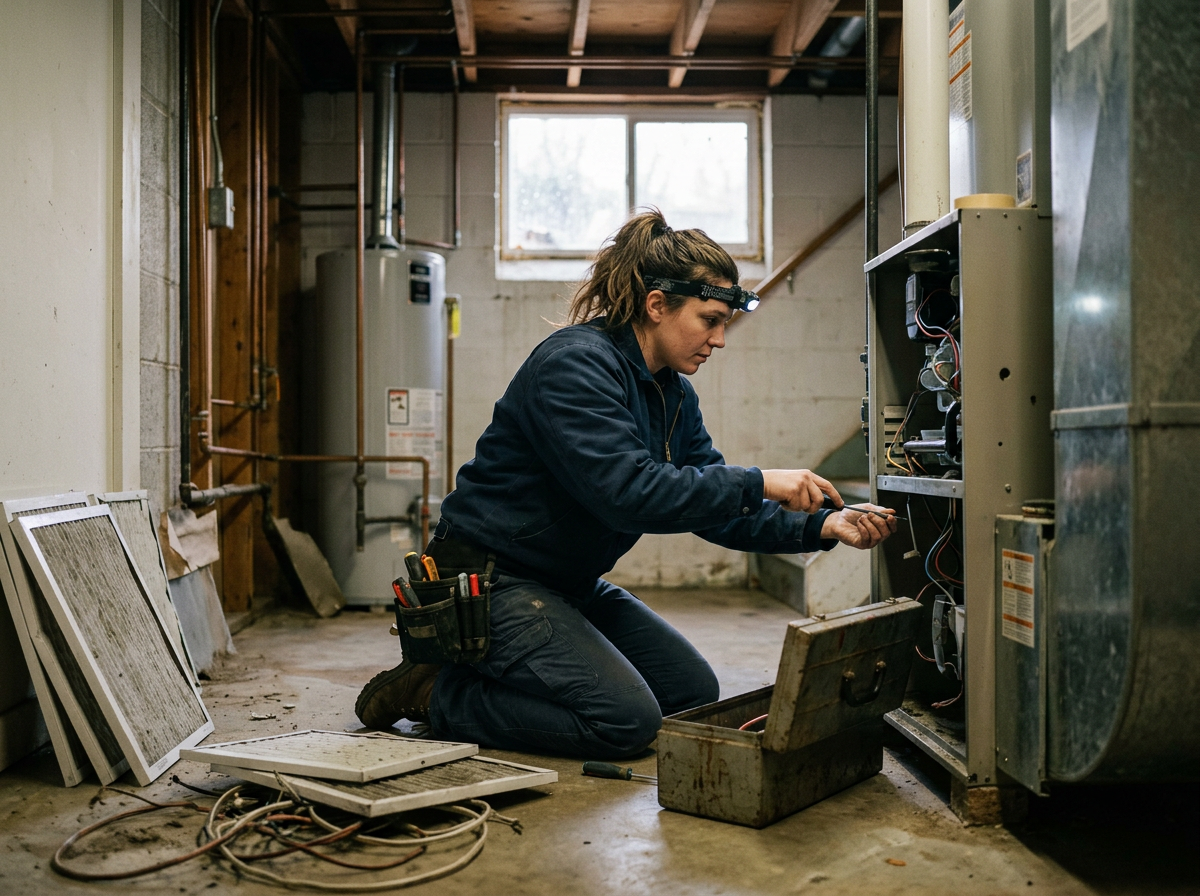
Boise winter inversions keep furnaces running for days without cycling off, which accelerates wear on inducer motors, hot-surface igniters and heat-exchanger seams. Technicians start every call with a systematic sequence: confirm thermostat demand, check 120-volt supply and safety switches, measure manifold pressure, and inspect venting for ice or soot before opening the cabinet. This order prevents misdiagnosis when a single failed component mimics several others during sustained load.
In North End and East End homes, retrofitted duct runs often create high static pressure that shortens inducer life even further. Repair crews carry manometers on every truck and correct blower speeds or add returns before replacing motors that would otherwise fail again within weeks. Propane units on the rural edges of Star and Middleton require orifice and regulator checks that natural-gas systems in Meridian do not, so parts kits are stocked accordingly.
Hard water in the Treasure Valley leaves mineral scale inside condensate drains and humidifier solenoids, turning minor leaks into no-heat calls during cold snaps. Technicians flush lines and replace float switches on site rather than scheduling follow-up visits. Wildfire-smoke seasons also increase filter-change frequency, and crews note when restricted airflow has contributed to limit-switch trips before leaving the job.
After any repair the system is run through a full cycle while monitoring temperature rise and CO levels to confirm safe operation before the technician departs. Homeowners receive a written summary of what failed, why the inversion load exposed it, and which filters or settings will reduce future strain.
Technician insight
In Boise the inversion periods are what catch most people out with Emergency Furnace Repair; the furnace never gets a break so a marginal igniter or inducer that would last another season in milder climates fails on the third straight day of sub-freezing basin air, especially in the 1920s bungalows where the mechanical closet was never designed for today’s higher static pressure.
North End Bungalow No-Heat Call
A 1928 North End home lost heat after four days of inversion temperatures. The inducer motor had seized from continuous run time and the resulting back-pressure tripped the rollout switch. We replaced the motor, cleared the venting path, verified proper draft, and the furnace resumed normal cycling without further shutdowns.
Emergency Furnace Repair Services We Offer
✓No-Heat Diagnostic Calls
Full electrical, gas-pressure and venting inspection that isolates whether the problem is control, airflow or combustion before any parts are ordered.
✓Inducer Motor Replacement
Direct replacement of failed draft inducers that have worn from days of continuous inversion-driven operation common in the Treasure Valley.
✓Hot-Surface Igniter Service
Testing and replacement of igniters cracked by repeated thermal cycling during prolonged cold-weather runs.
✓Heat-Exchanger Leak Inspection
Camera and pressure testing to locate cracks that develop faster under sustained high-fire conditions in Boise winters.
✓Condensate Drain Clearing
Flushing and repair of drains clogged by hard-water scale that causes safety switch shutdowns during emergency calls.
✓Limit-Switch and Safety Circuit Repair
Replacement of tripped limits and faulty rollout switches that shut down furnaces stressed by restricted airflow or venting issues.
Emergency Furnace Repair Cost in Boise, ID
| Service | Typical Range | What Affects It |
|---|---|---|
| Diagnostic visit | $95–$150 | Credited toward repair; higher in rural Star or Middleton propane homes |
| Inducer motor replacement | $450–$750 | Varies by model and whether venting modifications are needed in tight North End closets |
| Hot-surface igniter | $180–$320 | Includes testing of related safety circuits |
| Condensate drain service | $140–$280 | Includes flush and switch replacement when scale from hard water is present |
| Limit switch replacement | $160–$290 | Often paired with airflow correction in older East End duct systems |
Ranges are typical for Boise, ID and confirmed with an exact written quote before any work starts.
How it works
- 1
24-Hour Dispatch
Answer the call, confirm fuel type and symptoms, and route the nearest technician with the correct parts kit for gas or propane systems.
- 2
On-Site Safety Check
Verify CO levels, gas shutoff access and electrical supply before opening the furnace to protect the household.
- 3
Component Diagnosis
Run the systematic sequence of voltage, pressure and airflow tests to pinpoint the exact failure created by inversion load.
- 4
Repair And Verification
Replace or clean the part, restore operation, then monitor a full cycle for proper temperature rise and venting.
- 5
Homeowner Walk-Through
Explain the failure, show the old part, and advise on filter changes or settings that reduce future emergency calls.
Pricing
Upfront range given after diagnosis; final price depends on parts required and accessibility.